
Studded Bed Coils Manufacturer India | AFBC Boiler Bed Coils
High-Density In-Bed Evaporator Coils for Severe Abrasive Bed Combustion
Specifically engineered for the aggressive turbulence inside AFBC (Atmospheric Fluidized Bed Combustion) furnace beds. Our studded bed coils utilize automatic capacitor-discharge welded alloy studs that anchor protective refractory matrices, dissipating abrasive bed particle impacts while maintaining superior in-bed evaporative heat transfer rates.
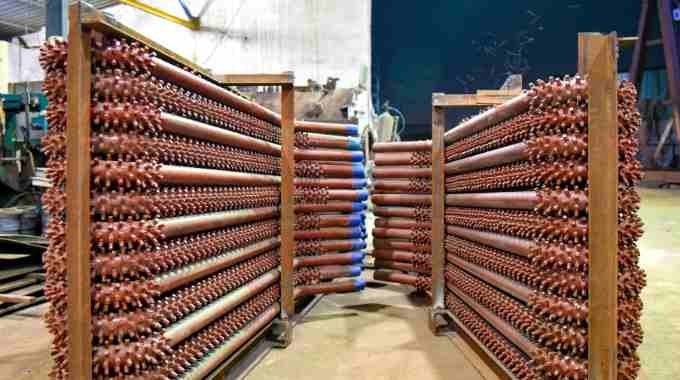
What is Studded Bed Coils?
Studded Bed Coils are heavy-duty in-bed evaporator tubular coils engineered for severe abrasion resistance inside AFBC (Atmospheric Fluidized Bed Combustion) and bubbling bed boilers. Modern Boilers Pvt. Ltd. manufactures studded bed coils utilizing automated capacitor-discharge welded alloy studs (180–250 studs/meter) that anchor a protective dense refractory matrix, shielding parent SA210 Grade C or SA213 T11 tubes from silica sand impingement while providing superior in-bed evaporative heat transfer. Every coil is 100% torque shear tested to exceed 450 MPa and hydro-tested to 220 kg/cm² with IBR Form III-A certification.
Manufacturing & Engineering Parameters
Every component is designed, formed, and tested under strict adherence to the Indian Boiler Regulations 1950 and ASME Section I Power Boilers code.
| Parent Tube Metallurgy | ASTM SA210 Gr. C, SA213 T11, SA106 Gr. C |
| Stud Metallurgy | Heat-resistant Carbon Steel, SS 304, SS 310 alloy |
| Stud Density | 180 to 250 studs per linear meter (custom pitch) |
| Outer Diameter (OD) | 50.8 mm to 63.5 mm (2.0" to 2.5") |
| Wall Thickness (WT) | 5.0 mm to 7.1 mm heavy wall |
| In-Bed Operating Temp | 850°C to 950°C bed temperature exposure |
| Bending Method | CNC Hydraulic Cold Bending with internal mandrel |
| Stud Weld Shear Strength | 100% torque shear tested to exceed 450 MPa |
| Hydrostatic Test | Tested at 220 kg/cm² for 30 minutes duration |
Industrial Applications & Boiler Types
- AFBC in-bed evaporators firing high-ash Indian coal (ash up to 48%)
- Multi-fuel fluidized bed boilers burning rice husk, dolochar, and coal rejects
- Re-tubing retrofits for erosion-damaged bubbling fluidized bed boilers
- Circulating fluidized bed (CFBC) bottom furnace loop seals
Quality Control & NDT Testing
- Automated stud welding gun ensures uniform fusion depth without burn-through
- Magnetic particle inspection (MPI) on 100% of stud weld fillets
- Supplied with custom erosion shields and sacrificial clamp guards
- IBR Inspector witness inspection with Form III-A test certificates
Direct heavy trailer dispatch from Nagpur MIDC to Chandrapur (3 hrs), Bhilai (6 hrs), Raipur (7 hrs), and Hazira (20 hrs).
Frequently Asked Engineering & Procurement Questions
Technical answers curated directly by our senior boiler design engineers for plant heads, O&M managers, and procurement teams.
Request Technical Quote & Drawing Review
Submit your tube schedule, drawing number, or replacement bill of quantities (BOQ). Our engineering desk in Nagpur provides commercial proposals within 4 business hours.
Related Boiler Pressure Parts & Fittings
Modern Boilers designs and manufactures high-performance radiant, platen, and convective superheater coils for high-pressure power generation and industrial process boilers. Cold mandrel bent with strict ovality limits and post-weld heat treatment, our coils ensure maximum steam enthalpy and heat absorption while resisting high-temperature flue gas corrosion and creep fatigue.
Membrane water wall panels form the perimeter combustion chamber of modern water-tube boilers. Fabricated on our automatic submerged-arc welding (SAW) gantries, our gas-tight panels eliminate fugitive flue gas egress, lower refractory maintenance costs, and provide maximum radiant evaporative surface area for rapid steam generation.
Even fluidization is the single most vital factor in preventing catastrophic bed clinkering and boiler trips in AFBC and CFBC boilers. Our directional and mushroom-type air nozzles are engineered with calibrated discharge orifices that provide uniform air velocity distribution across the entire bed plate while preventing bed material back-sifting into the windbox.